
Toy Libraries - a pathway to prosperity
Why is it, that after 25 years consulting and researching in the public library sector across Australia, that I have only now come to realise the value and potential of Toy Libraries? How did someone not point this out to me? How did I not work it out for myself? Why do these mostly small-scale volunteer-run community assets just sit to the side without ever being recognised as an early stepping stone in our nation’s future economic, wellbeing and cultural prosperity?
How did I get here? Well two things actually.
First, we undertook a review of a public library that had in the past 18 months taken on responsibility for several toy libraries when their original body of management had been unable to continue and Council stepped in to keep the toy libraries afloat. We spent some time in their libraries, looking at their collections, chatting to library staff, watching the joy on the faces of children playing and parents comparing notes on everything child-raising.
Second, I came across Think Impact’s Valuing play: The social impact of toy libraries in Australia (a social return on investment analysis), a research report funded by the Department of Social Services and the Department of Health, Disability and Ageing. The report documents the value of toy libraries in terms of benefits for parents and children, for the early years system, for volunteers and for Government.
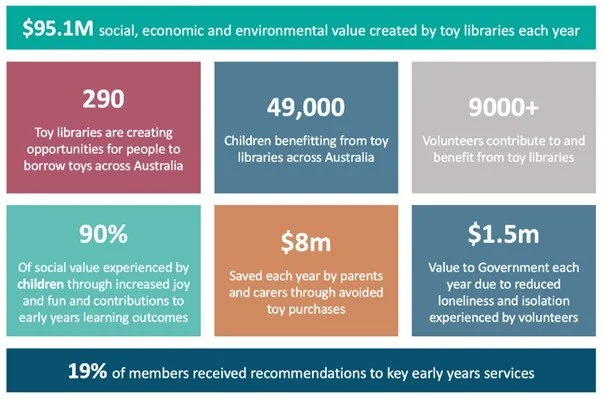
But nowhere in that very good report was there reference to the potential connection between toy libraries and public libraries, and the missed opportunity in early years literacy development. Consider this:
Toy libraries appeal to young families, especially low-income families and especially during a cost-of-living crisis. Parents can take their kids to the library, test out play with a selection of toys (which assists in the development of both gross and fine motor skills), and borrow some items to take home for a few weeks without incurring the cost of purchase.
What if the local public library partnered with the toy library and put a selection of children’s books there for parents to browse, borrow or take? These could be from the public library collection and borrowable via self-checkout if families sign up to be library members. They might be discards that are free to take home and return via an honour system, or they might be free to take – full stop.
What if the local public library also ran an early years literacy activity at the toy library on a weekly, fortnightly or monthly basis? Encouraging parents to read to their children at home, and cross-promoting the larger collections and range of programs available at the public library.
This could lead to:
a more engaging offering for the toy library
more books in the homes of young families
more reading to young children at home … with all of the literacy, learning, employment, economic, health and social outcomes that are known to flow from that
more public library members … and maybe even parents borrowing items from the library for themselves
the beginning from a very young age of a lifelong connection to the library and the wider range of services on offer.
I’m not suggesting that this is a simple cost-free exercise. I’m not proposing integration or take-overs. I’m seeing two organisations working together to realise their complementary objectives, and I know this takes time and effort. But from a community perspective – for the young family and their children – it seems to make sense. And if you could test and trial this in one place, and demonstrate the benefits, then you have a model that could be rolled out in other places. And maybe, just maybe, you could catch the attention of government agencies, corporates and/or philanthropics who can’t resist a photo op with beaming children’s faces (sorry, touch of cynicism there).
Now a model like this might already be happening out there – I hope it is.
Play … Read … Learn … Thrive … Live well.
And if it truly is can we hear about and find a way to turn that community goodness into a compelling story.